
Sharkey Jail Release Paths
The official county description identifies the Sharkey County Sheriff as the county jailor and says the office keeps the jail docket. It does not identify a separately named detention center. For that reason, “Sharkey County Jail” describes the local detention and docket function, not a verified building name with its own public portal. A person may leave that local custody in several ways. Bond, own-recognizance release, time served, or satisfaction of a local order may return the person to the community. A transfer may instead place the person with MDOC, another county, the U.S. Marshals Service, a medical provider, or an immigration authority.
The distinction belongs in the event record. Ask for the release date and time, release reason or code, and any destination or receiving agency. A bond release does not end the case. Likewise, a court dismissal may not cause immediate physical release if another charge or hold remains. The court order and the sheriff's event answer different questions, so preserve both dates rather than merging them.
| Docket event | What it can mean | Next check |
|---|---|---|
| Community release | Local physical custody ended | Confirm date, time, and court conditions |
| MDOC commitment | Custodian changed to the state system | Use the MDOC Inmate Search |
| Other-agency transfer | Another authority took custody | Identify the receiving agency |
| Court transport | A movement, not proof of release | Check the return or later event |
Confirm a Sharkey Jail Release
No official Sharkey County roster, archive, booking portal, or release tab was found in the research sweep. The practical route is a name-specific inquiry to the Sheriff. Use the person's full legal name and a narrow booking or arrest date range. A date of birth, alias, booking number, or case number can help staff separate similar names, but personal identifiers should be given to the custodian rather than posted in public.
- Contact the Sharkey County Sheriff and ask whether the person is held, released to the community, or transferred.
- Request the date, time, event type, and destination shown in the jail docket.
- If MDOC received the person, use the state Inmate Search by name or MDOC number and read the status and date labels exactly.
- Check the proper Sharkey court for the order, disposition, or sentence that led to the event.
- For an older entry or a copy, send a narrow Mississippi Public Records Act request.
The broader Sharkey County released-inmate search explains how the sheriff, court, MDOC, VINELink, BOP, and ICE paths fit together. Use the custody system that actually held the person. An MDOC result does not document a county-only bond release, and a county docket does not prove a later state discharge.
Sharkey Jail Release Records
A useful record request names an existing record rather than asking staff to research an open-ended question. Request the jail-docket, booking, and release entry for one person and an approximate booking date. Ask for the booking number, booking and release timestamps, release or disposition code, and destination or receiving agency if those fields are maintained and nonexempt. The official county site does not publish a field schema, so the request should not assume that each field exists.
Mississippi Code Section 25-61-5 governs access and copying under the Public Records Act. If an agency has no adopted written procedure, the statute states a one-working-day access rule. An adopted procedure cannot set production or denial later than seven working days. When production cannot occur by then, the body must explain the delay with particularity, and the statute sets a fourteen-working-day outside point absent mutual agreement. Actual-cost search, review, copying, mailing, and redaction charges may apply. Ask for an itemized estimate before chargeable work.
Electronic copies can be requested when the record is kept electronically. If part of the record is withheld, ask for the nonexempt portion and the specific legal basis for each withholding. The county publishes no jail-record form, online portal, fee schedule, records hours, or retention period. Ask the sheriff whether email is accepted as a formal request and where inspection currently takes place.
Note: A focused date range is more likely to identify an existing docket entry than a request for every record about one person.
Sharkey Jail Records Contact
The official contact is the Sheriff's Office page. It is both the supported starting point and the source for the jailor and jail-docket duties. Call before traveling because the site does not publish records-unit hours, a secure detention entrance, or family pickup instructions.
Sharkey County Sheriff's Office
Sheriff: Herbert Ceaser
Address: 120 Locust Street
Rolling Fork, MS 39159
Phone: 662-873-1500
Fax: 662-873-6135
Email: hceaser@sharkeycountyms.com
Hours: Not published; call ahead
The official Sharkey County Sheriff page shows the local jailor contact and no public roster link. The captured page preserves that interface finding.
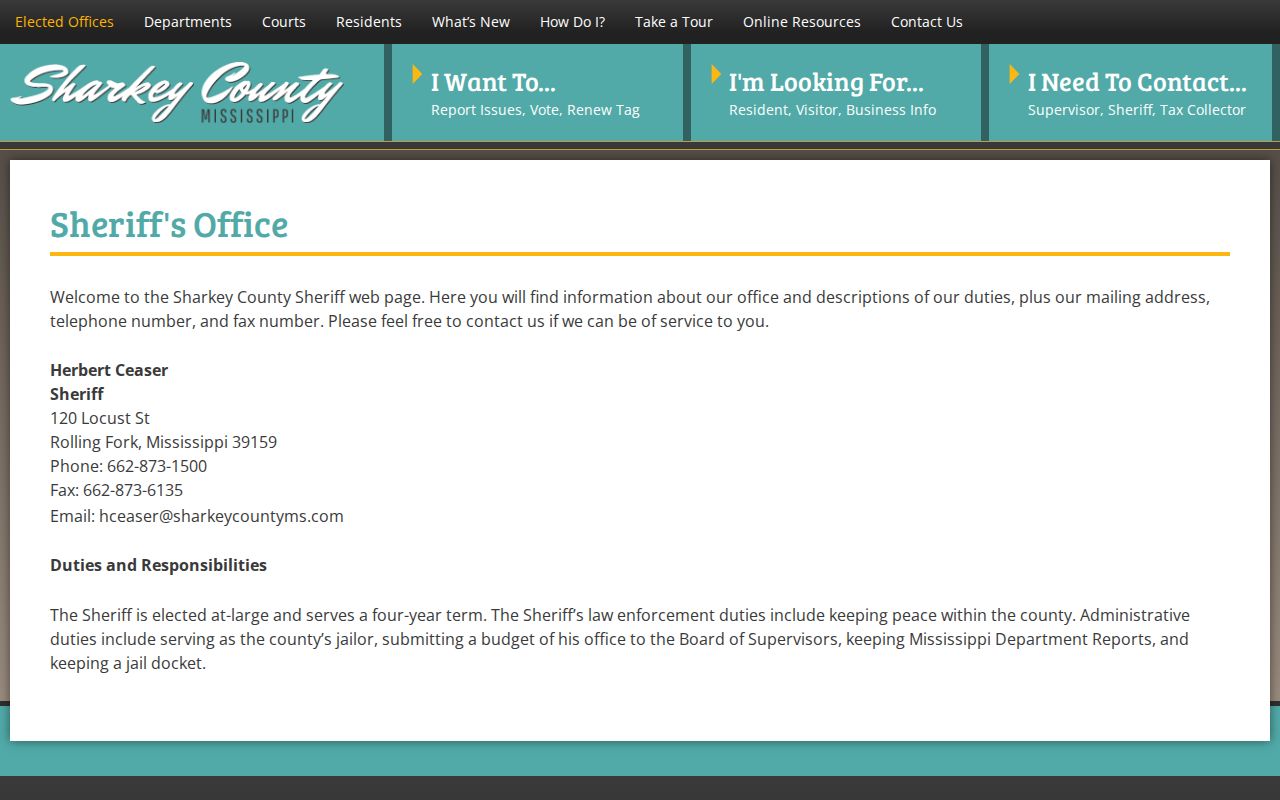
The image supports the call-and-request route; it does not show a release feed or prove any named person's status.
Sharkey Jail Court Records
Once the physical event is known, the court file can explain what authorized it. Sharkey County Circuit Court has jurisdiction over felony criminal matters after indictment. Justice Court handles initial felony appearances, DUI matters, county ordinances, and other matters within its authority. The county says Justice Court holds jail sessions three times each week, but that schedule is not a promise of a release time.
Use the case number when possible. Ask for the docket sheet, charging instrument, plea or verdict, sentencing order, dismissal entry, revocation order, or later order that changed the sentence. A signed order is stronger evidence of its legal terms than a short electronic docket label. Yet the court file still does not replace the sheriff's release timestamp. An order can be entered before staff process a release, while another hold can keep the person in custody.
- Release
- The end of custody by one named custodian, which may or may not return the person to the community.
- Transfer
- A move to another custodian, not community release.
- Discharge
- Completion of a sentence or supervision status as documented by the responsible authority.
- Detainer
- A request or hold from another authority that may prevent community release.
Sharkey Jail Access After Tornado
The March 24, 2023 tornado significantly damaged Sharkey County government offices and caused temporary operating arrangements. Current county pages again list 120 Locust Street for the Sheriff and courts. That does not make older entrances, directions, or hours reliable. Anyone planning an in-person record inspection, family pickup, or court visit should call the responsible office first and confirm where the service is now provided.
This local history must be kept in its proper lane. Office disruption is not evidence that the jail closed, that a person was released, or that a record ceased to exist. It only explains why call-ahead verification matters more than recycled directory information. The county tornado recovery page is the source for the disruption, while the Sheriff remains the source for a named custody event.
Note: Use current county contacts, since an old map pin or office schedule may reflect a temporary post-storm arrangement.
Sharkey Release Evidence Limits
Positive evidence should identify both the custodian and the event. A Sharkey jail-docket timestamp, paired with the event code and any receiving agency, can show what happened to local custody. A signed court order can explain the legal basis. An MDOC admission or discharge record covers the state stage, while a BOP locator result covers a federal sentence. Keep each identifier separate: Sharkey booking number, court case number, MDOC number, and BOP register number are not interchangeable.
Negative evidence is weaker. No web result, no VINELink match, a blank MDOC tentative date, or an absent court document may reflect spelling, delay, nonparticipation, restricted material, transfer, or the limits of the system searched. Record the finding as “not found in this system.” Do not convert it into “released.” For a sound conclusion, seek an affirmative event from the agency that held the person and date the check because contacts, facility operations, and interfaces can change.
Older Sharkey events may require more than one request. Ask the Sheriff for the jail-docket event, then use the Circuit Clerk or Justice Court record to place that event in the case timeline. A sealed, juvenile, or expunged matter may not be publicly available, and a custodian may redact protected content. Respect those limits. If the agency no longer keeps the requested period, ask for the applicable retention schedule or records-disposition authority instead of assuming that the event never occurred.