
Sharkey Projected Versus Actual Release
MDOC uses the exact label Tentative Release Date. It is a calculated planning date based on the commitment papers, sentence structure, jail credit received by MDOC, earned-time eligibility, and later changes. It is not an appointment, pickup time, or guarantee. The actual release record documents what occurred, including the date, time, authority, and destination when those fields are maintained.
A Sharkey County pretrial detainee has no computed end-of-sentence date. Release can turn on bond, recognizance, dismissal, a court order, and any other hold. Even after a judge acts, jail staff must process the event. A person may instead transfer to MDOC, federal custody, another jail, a medical custodian, or immigration custody. That is not community release.
For a sentenced state prisoner, distinguish the tentative release date from parole eligibility, an earned-release-supervision date, and the full discharge date. Each answers a separate question. An MDOC location also describes assignment, not release.
Find a Sharkey Projected Release
Begin with the legal name and the right system identifier. The MDOC Inmate Search accepts first name, last name, or MDOC ID. It covers state custody and sentence records, not each county-only arrest. The Sharkey County Sheriff is the first contact for a county booking or local sentence. The court supplies the signed order that establishes the sentence terms.
- Ask which agency has custody now. Confirm whether the person is pretrial, serving a county term, committed to MDOC, or held under another authority.
- For MDOC custody, search by MDOC number when possible. Compare identity details, location, sentence rows, and the exact Tentative Release Date label.
- Obtain the signed sentencing orders. Record the start date, sentence length, and whether multiple terms run concurrently or consecutively.
- Confirm that pre-sentence jail credit was certified to MDOC. Ask MDOC Records for the current time sheet when the calculation matters.
- For a Sharkey County sentence, ask the Sheriff for the county time computation and credited days. Do not substitute the MDOC framework unless MDOC administers that sentence.
- Recheck with the actual custodian near the date. Ask whether a detainer, new order, transport, or release-plan issue changes the destination or timing.
The complete Sharkey County release-record search shows how the Sheriff's event entry and the court disposition fit around the projected date.
The official MDOC example record demonstrates the field label and page layout.
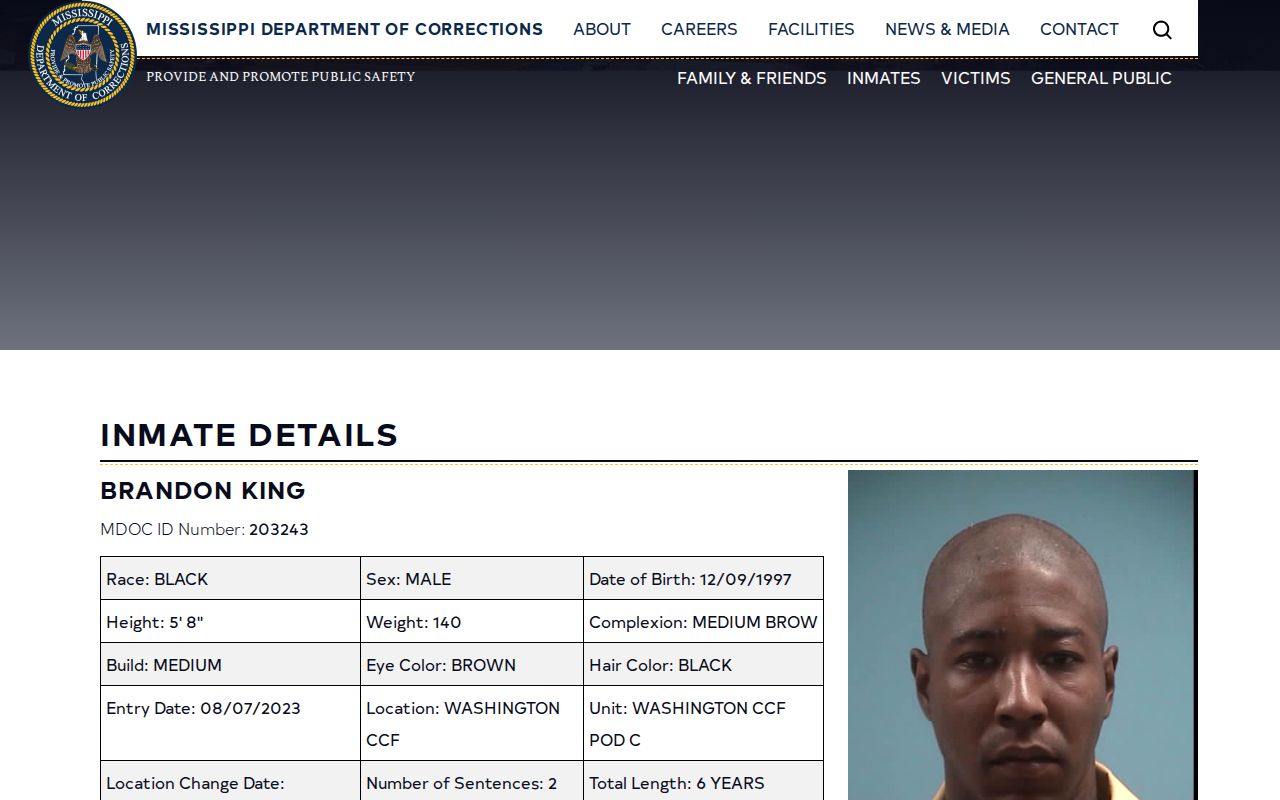
The image is interface evidence only. Use the live record and avoid carrying an old date forward after the calculation changes.
Read Sharkey MDOC Date Records
An MDOC detail record can display the person's name, MDOC ID, identifying traits, date of birth, entry date, assigned location and unit, location-change date, number and total length of sentences, offense-level sentence facts, a photograph, and the Tentative Release Date field. Those fields help separate similar names and trace the calculation, but no single field stands alone.
Read sentence rows one at a time. Different cases may carry different start dates, counties, and lengths. Concurrent terms run together to the extent the orders direct, while consecutive terms run in sequence. The controlling end date cannot be inferred from the longest row without reviewing all orders and the MDOC time sheet. A location-change date shows movement within the system, not a Sharkey County release.
| MDOC field | What it can establish | What it cannot establish |
|---|---|---|
| MDOC ID | The state record identifier | Identity without comparing other details |
| Location or unit | Current MDOC assignment shown | Community release |
| Sentence rows | Offense-level terms and dates displayed | The final calculation without the orders and time sheet |
| Tentative Release Date | MDOC's current public planning date | A guaranteed hour or destination |
| Parolees Search result | Ongoing parole represented in the public registry | The date the person left the institution |
A blank tentative date does not prove release. The research found no public MDOC filter for all released or discharged people, and a fully discharged person may leave the active inmate and parolee widgets. Request a discharge certificate or completed release record when the past event is the real question.
Mississippi Earned-Time Release Rules
Mississippi Code § 47-5-138 is the central earned-time statute. Eligibility and exclusions vary by offense, sentence, and statutory classification. Section 47-5-139 addresses forfeiture and possible restoration of earned time. The current statute and the individual time sheet control.
The common 85 percent shorthand reflects part of Mississippi's truth-in-sentencing and earned-time framework for covered terms. It is not a universal calculator. Offense type and date, habitual status, a mandatory minimum, consecutive sentences, program credit, forfeiture, and later legislation can alter the result. Multiplying every sentence by .85 can produce a false Sharkey County release date.
MDOC also distinguishes ERS, or earned-release supervision, from full discharge. A person can leave the institution while still under MDOC jurisdiction for the balance of an eligible term. Residence review may affect community placement near the date. The displayed date must therefore be read alongside the current status and sentence details.
The MDOC Types of Supervision page illustrates ERS and its relationship to the 85/15 example.
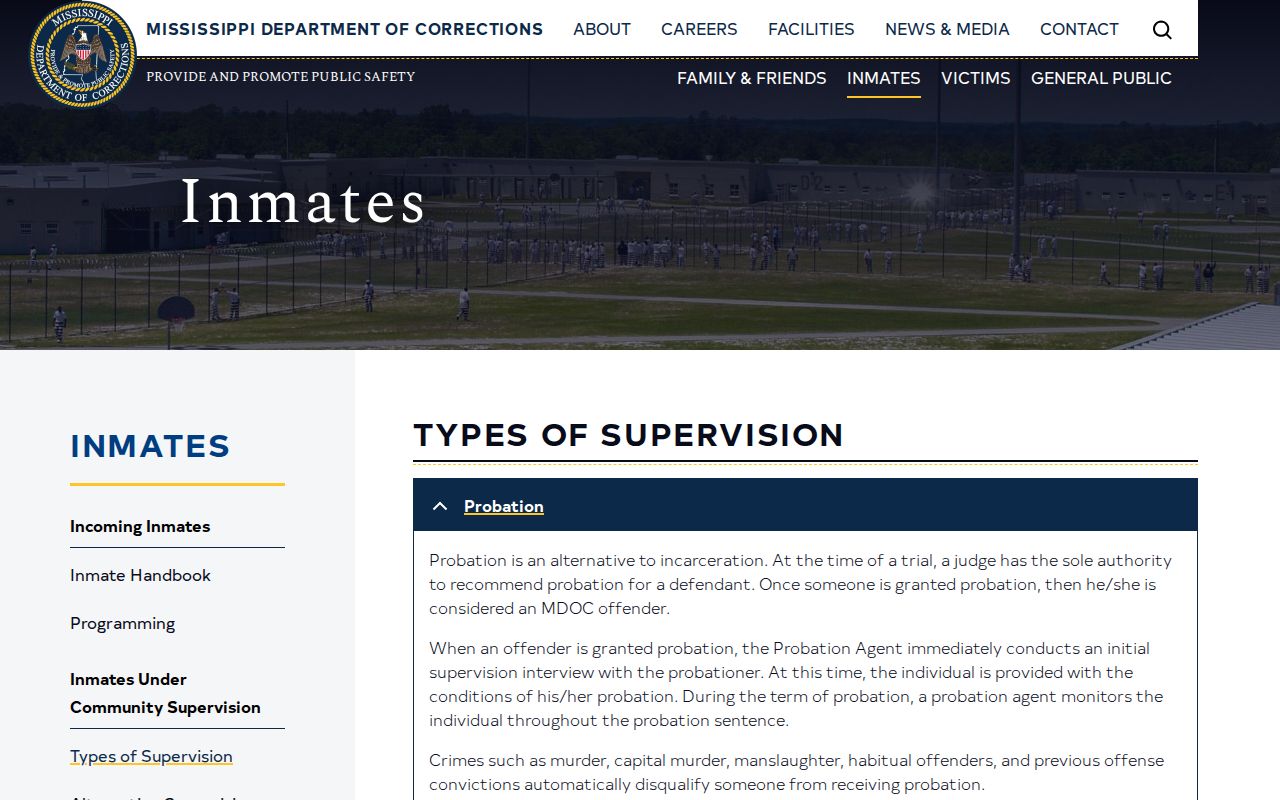
The example explains a category, not an individual Sharkey County computation. Confirm eligibility and time credit with MDOC.
Note: Earned time and parole eligibility are separate calculations, and neither proves the date or hour of physical release.
Why Sharkey Release Dates Change
A tentative date changes when the inputs or legal rules change. Some events alter the computed date. Others leave the date intact but change whether the person enters the community or moves to another custodian. Record both the calculation and the destination.
| Factor | Possible effect | Best confirmation |
|---|---|---|
| Certified jail credit | Corrected credit can change the time sheet | Signed judgment, certified credit, MDOC Records |
| Concurrent or consecutive terms | Controls which sentence end date governs | Each sentencing order and MDOC time sheet |
| Earned-time forfeiture or restoration | Can move the tentative date | MDOC record under §§ 47-5-138 and 47-5-139 |
| Amended judgment or recalculation | Changes a legal input | Issuing court and MDOC Records |
| Detainer or other hold | May send the person to another authority rather than the community | Current custodian and receiving agency |
| Parole action | Eligibility or a grant affects release planning but is not release itself | Parole Board and Community Corrections |
| Residence approval | An unapproved plan can delay community placement | MDOC case staff or Community Corrections |
MDOC's FAQ describes a discharge certificate before release and says release planning can take weeks in its process. That guidance should not be turned into a fixed deadline, and it does not apply to a Sharkey bond release.
Confirm Sharkey Physical Release
A projected date becomes an actual event only when the custodian records the release or transfer. For a Sharkey booking, contact the Sharkey County Sheriff and ask for the jail-docket entry, release date and time, type or code, and destination. If the answer is transfer to MDOC, the county event marks a change of custodian, not freedom from custody.
For an MDOC term, request the time sheet or completed release and discharge record from MDOC Records. A fully discharged person may no longer appear in active inmate or parolee tools. The signed court order provides sentence terms but not the exact time staff completed release.
VINELink/MS SAVIN may supply an alert after a participating agency sends an event. The Sharkey VINELink inmate search explains registration and data limits. An alert can lag, and a transfer message must not be relabeled as release.
Sharkey County Release-Time Rules
No official Sharkey County publication found in the research states a county good-time formula, fixed daily release hour, or weekend and holiday early-release policy. That absence is a substantive local rule for the search process. Do not apply MDOC's statutory framework to a county sentence merely because both are in Mississippi.
Ask the Sheriff for the actual local time computation and credited days. Pair that response with the sentencing order held by the issuing court. If the listed date falls on a weekend or holiday, ask what the custodian will do rather than promising an earlier Friday release. No supported Sharkey source establishes such a practice.
County pages list the Sheriff at 120 Locust Street, Rolling Fork, but they do not separately identify a secure detention entrance or release desk. Call before travel. A pickup plan should be based on a confirmed release event and location, not the date shown in a different custody system.
A Sharkey court record is an essential input, not a substitute for the release log. Ask for the signed sentencing order, any amended judgment, and orders that address credit or revocation. The Sheriff can then explain the county calculation it applies. If staff say another facility held the person, identify that custodian and obtain both the Sharkey transfer entry and the holding facility's event record.
The county's lack of an online roster also means no public interface shows a countdown to local release. A disappearance from an active view, if one is checked through staff, could mean community release, transfer, court transport, or another hold. Require an affirmative event type and destination.
Note: County time computation, MDOC earned time, parole eligibility, and actual release are four distinct facts that may carry different dates.
Sharkey Parole Eligibility Dates
Parole eligibility is governed mainly by Mississippi Code § 47-7-3 and the law applicable to the offense and sentence date. Eligibility means the Board may consider the case. It is not a parole grant and not an actual release date.
Offense classification, habitual status, mandatory terms, multiple sentences, and later amendments can alter the rule. Earned time does not simply erase a parole minimum. After a favorable decision, an approved plan, detainer resolution, and MDOC processing can remain. The authoritative answer comes from the Board for its decision and MDOC for the sentence computation.
Question: Does a blank tentative-release field mean the person was released? No. It may reflect record status, calculation limits, or missing display data. Seek an affirmative MDOC release or discharge record.